Week in IT Digest #56
- Krzysztof Kosman

- Sep 11, 2025
- 6 min read
The single most important news this week is OpenAI’s $300B, 4.5‑gigawatt compute pact with Oracle—it signals AI’s full industrialization, where access to massive, reliable, and affordable compute becomes the new competitive moat for every builder, from startup founders to enterprise dev teams.
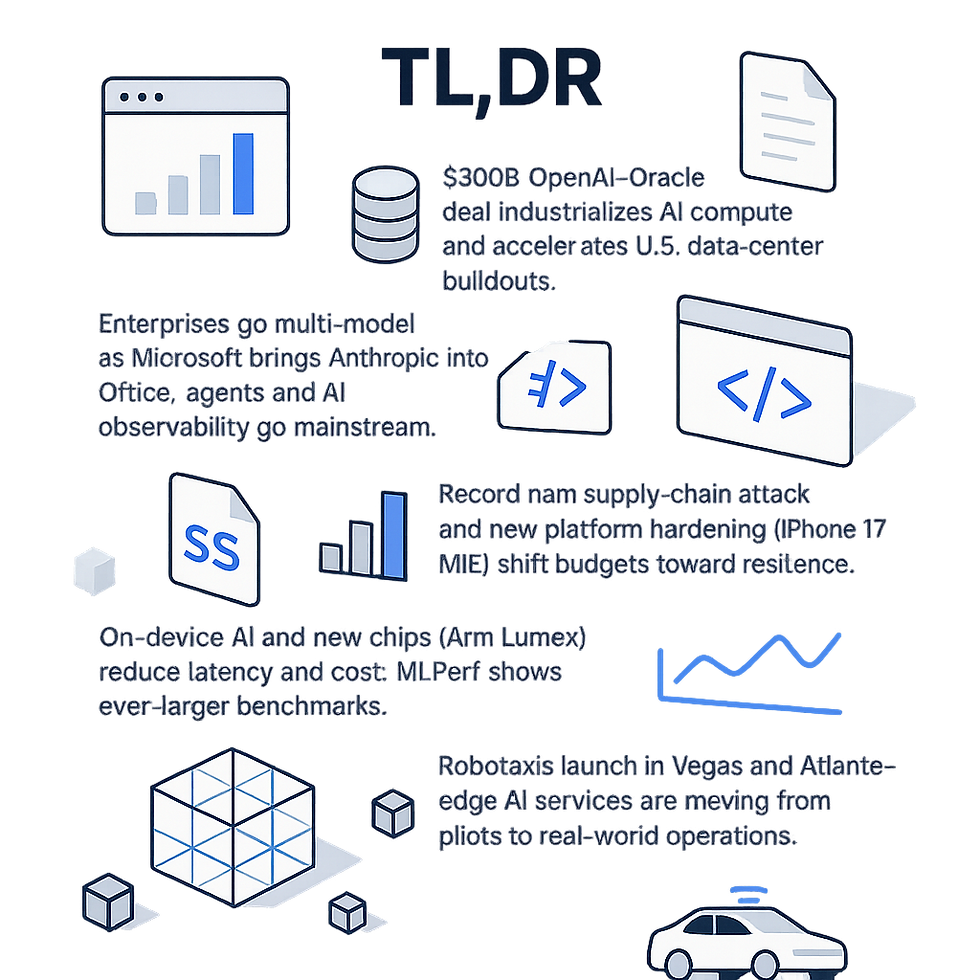
TL;DR
$300B OpenAI–Oracle deal industrializes AI compute and accelerates U.S. data-center buildouts.
Enterprises go multi-model as Microsoft brings Anthropic into Office; agents and AI observability go mainstream.
RSL licensing signals paid, enforceable data usage for training and inference; courts tighten privacy and copyright.
Record npm supply-chain attack and new platform hardening (iPhone 17 MIE) shift budgets toward resilience.
On-device AI and new chips (Arm Lumex) reduce latency and cost; MLPerf shows ever-larger benchmarks.
Robotaxis launch in Vegas and Atlanta—edge AI services are moving from pilots to real-world operations.
Funding remains strong (Replit, Mistral, Reflection AI, CuspAI), even as export and regulatory pressures rise.
Change Summary
The AI stack is entering its industrial phase. The OpenAI–Oracle pact is not just a spend headline—it formalizes compute as a utility, shifting power to those who can guarantee capacity, energy, and cooling at continental scale. That scale will push procurement to resemble traditional enterprise IT: multi-year commitments, penalties, and hard SLAs—while multi-model strategies (e.g., Microsoft adding Anthropic) reduce single-vendor risk and force model providers to compete on reliability, TCO, and domain performance, not just benchmarks.
As this matures, observability, AI asset management, and agent governance become mandatory layers in the enterprise stack. Concurrently, data is moving from gray-market scraping toward licensed marketplaces. The RSL standard and court pushbacks imply that future foundation and vertical models will carry explicit content rights and per-inference economics. Expect higher cost of goods sold for model providers—offset by better quality, auditable provenance, and safer enterprise adoption. This will incentivize leaner architectures, more on-device inference (Arm Lumex, Apple’s MIE), and hybrid patterns that minimize token and egress costs while hardening privacy.
Security is the counterweight to scale: the record npm supply-chain incident, SAP zero-days, and platform hardening on iOS/Windows demonstrate that AI-era productivity depends on securing developer pipelines, dependencies, and endpoints. Second-order effect: budget shifts from experimentation to resilience—software SBOMs meet AI BOMs; red-teaming extends to agent workflows; and customers will treat outages (Anthropic) and misconfigurations as vendor risk, pricing reliability into contracts.
Meanwhile, autonomous mobility deployments hint at a near-term edge-AI wave—opening greenfield niches for real-time inference, mapping, and safety systems, but only for teams that can weave compliance, telemetry, and fail-safes into their product DNA.
Change Patterns
Compared with mid-summer, when Nvidia’s $4T milestone framed AI as an investment supercycle, this week shows the operationalization of that thesis: compute is being locked in via decade-scale contracts (OpenAI–Oracle), and clouds are reporting massive RPOs and commitments.
What’s changed is a pragmatic pivot from single-model allegiance to multi-model procurement (Microsoft + Anthropic), reflecting a discipline around cost, SLAs, and task-specific performance that wasn’t as visible weeks ago. Two reinforcing trends persist and mature: governance and security. Earlier weeks emphasized transparency and deepfake resilience; now we see enforceable licensing (RSL), tougher court stances on data misuse, and enterprise-grade AI asset management and observability.
In parallel, security incidents escalated—from policy debates to a record npm supply-chain hit—cementing secure SDLC, SBOM/AIBOM practices, and dependency hygiene as must-haves, not nice-to-haves. Infrastructure strategy has also evolved. The prior narrative celebrated hyperscaler and GPU dominance; today’s pattern blends that with on-device and edge efficiency (Arm Lumex, iPhone 17 MIE) and renewed interest in private/hybrid clouds for governance and cost control.
Developer experience is bifurcating: agentic tools are more powerful (Claude’s file editing), but outages and compliance burdens highlight vendor risk—driving demand for observability, reproducibility, and failover.
Finally, real-world deployments (robotaxis) and scientific bets (quantum, materials discovery) suggest a broader diffusion of AI beyond text and images into time-critical and physics-heavy domains, a continuation of the trend toward AI-native products with hard operational constraints.
Topic Clusters
AI infrastructure mega-deals and the compute capacity race
OpenAI and Oracle reportedly ink historic cloud computing deal read full article
OpenAI will purchase $300B of compute from Oracle over five years, marking one of the largest cloud deals ever.
Sources: OpenAI signed a contract with Oracle to purchase $300B in computing power, requiring 4.5 gigawatts of capacity, over roughly five years read full article
The deal demands roughly 4.5 GW of capacity, underscoring unprecedented data center build-out needs.
OpenAI Signs $300 Billion Data Center Pact With Tech Giant Oracle read full article
Oracle will fund and build over half of OpenAI’s planned U.S. AI data centers under the five-year agreement.
Oracle boasts $455B backlog from AI boom, but not all its new friends will live to pay up read full article
Oracle cites a $455B remaining performance obligation amid the AI boom, raising questions about customer durability.
Enterprise AI shifts: multi-model strategies, agents, and observability
Microsoft ends OpenAI exclusivity in Office, adds rival Anthropic read full article
Microsoft is integrating Anthropic into Office, signaling a multi-model supplier strategy for Copilot.
Claude can now edit and create files, including Excel spreadsheets read full article
Anthropic upgraded Claude to create/edit spreadsheets, documents, and presentations, pushing deeper workflow automation.
Adobe’s first AI agents are ready to rock and roll read full article
Adobe launched its first family of AI agents to enhance enterprise customer experiences and marketing automation.
Monte Carlo debuts a universal observability tool for AI inputs and outputs read full article
A new tool provides end-to-end observability for AI agent inputs/outputs to improve reliability and issue diagnosis.
SPLX launches AI Asset Management to map and secure enterprise AI stacks read full article
SPLX adds AI asset inventory and governance with model BOMs, vulnerability scanning, and workflow analysis.
Data licensing, regulation, and legal realignment
Reddit, Yahoo, Medium and more are adopting a new licensing standard to get compensated for AI scraping read full article
Publishers adopt Really Simple Licensing (RSL) to set enforceable terms and pricing for AI training and inference.
US Senator Ted Cruz introduces a bill that would let AI companies apply for exemptions from federal regulations read full article
A proposed bill offers two-year federal regulation exemptions to spur AI experimentation, drawing oversight concerns.
Big clouds scramble as EU Data Act brings new data transfer rules read full article
The EU Data Act compels major clouds to adjust data transfer and interoperability practices across the bloc.
Judge rejects Anthropic's record-breaking $1.5 billion settlement for AI copyright lawsuit read full article
A judge denied approval of a proposed $1.5B settlement over alleged training on copyrighted books, citing deficiencies.
Court rejects Verizon claim that selling location data without consent is legal read full article
Courts pushed back on carriers selling location data without consent, setting up potential Supreme Court review.
Security shockwaves: supply chain, platform hardening, and mobile threats
Software packages with more than 2 billion weekly downloads hit in supply-chain attack read full article
A massive npm supply-chain incident likely ranks among the largest ever, affecting billions of weekly downloads.
'ChillyHell' backdoor hid in notarized Mac apps for four years read full article
A Mac backdoor bypassed notarization since 2021, exposing gaps in Apple’s security review process.
SAP warns of high-severity vulnerabilities in multiple products read full article
SAP disclosed high-severity flaws across S/4HANA and NetWeaver and urged immediate patching.
Senator blasts Microsoft for making default Windows vulnerable to “Kerberoasting” read full article
Microsoft faced criticism for default RC4 usage tied to a major breach, spotlighting legacy crypto risks.
Lookout rolls out Smishing AI to stop social engineering on mobile devices read full article
Lookout introduced an AI-driven solution to detect and block smishing attacks that evade traditional defenses.
Hardware and on-device AI: benchmarks, chips, and next-gen compute
Machine Learning Tests Keep Getting Bigger read full article
MLPerf adds larger, tougher benchmarks as Nvidia, AMD, and Intel showcase next-gen inference performance.
Arm debuts AI-optimized Lumex chip lineup for mobile devices read full article
Arm launched AI-optimized CPUs, GPUs, and interconnects for mobile, powering stronger on-device AI.
iPhone 17 Introduces 'Groundbreaking' New Memory Security Feature read full article
Apple’s Memory Integrity Enforcement aims to harden iOS against sophisticated exploits at minimal performance cost.
Quantum computing startup PsiQuantum raises $1B, aiming to build 1M-qubit-scale machine read full article
PsiQuantum raised $1B to accelerate a million-qubit quantum system, signaling continued investment in post-classical compute.
Autonomous mobility and robotics step into service
Amazon's Zoox launches its autonomous robotaxi service read full article
Zoox launched a driverless robotaxi on the Las Vegas Strip with a purpose-built, wheel-free interior.
Lyft launches autonomous fleet with May Mobility in Atlanta read full article
Lyft and May Mobility debuted a safety-first autonomous pilot in Midtown Atlanta with human standby operators.
Here Come the Robotaxis: Zoox and Lyft Both Launch Driverless Ride Sharing read full article
Robotaxis are expanding in Las Vegas and Atlanta, though safety, scale, and regulation remain hurdles.
Humanoids, AVs, and what’s next in AI hardware at TechCrunch Disrupt 2025 read full article
Disrupt 2025 spotlights humanoids, autonomous vehicles, and the AI hardware roadmap.
Startup momentum: AI platforms, coding tools, and scientific discovery
Replit raises $250M at $3B valuation for its AI application builder read full article
Replit hit $150M ARR and 40M users, securing $250M to scale its AI development platform.
Mistral AI raises $2B led by semiconductor equipment maker ASML at $14B valuation read full article
Mistral’s $2B Series C more than doubles its valuation, reinforcing investor conviction in frontier models.
Sources: Reflection AI nears a deal to raise ~$1B read full article
Reflection AI is close to raising roughly $1B for AI coding tools, with Nvidia’s VC arm expected to lead a big slice.
CuspAI raises $100M to build AI ‘search engine’ to transform materials science read full article
CuspAI secured $100M to accelerate AI-driven discovery of new materials, bridging AI and scientific R&D.


